When the World Eats Lunch: 37 Million Meeting Minutes
We looked at 90 days of Wave recordings in 24 countries to find the moment the meetings stop. Americans barely pause. Italians vanish for two hours. Poland never leaves.
Wave AI records a lot of meetings. Over the last 90 days, about 48,000 people in 24 countries made just over a million recordings, 37 million minutes in all, which means we have an unusually precise view of a very ordinary question: when does everyone stop talking and go eat?
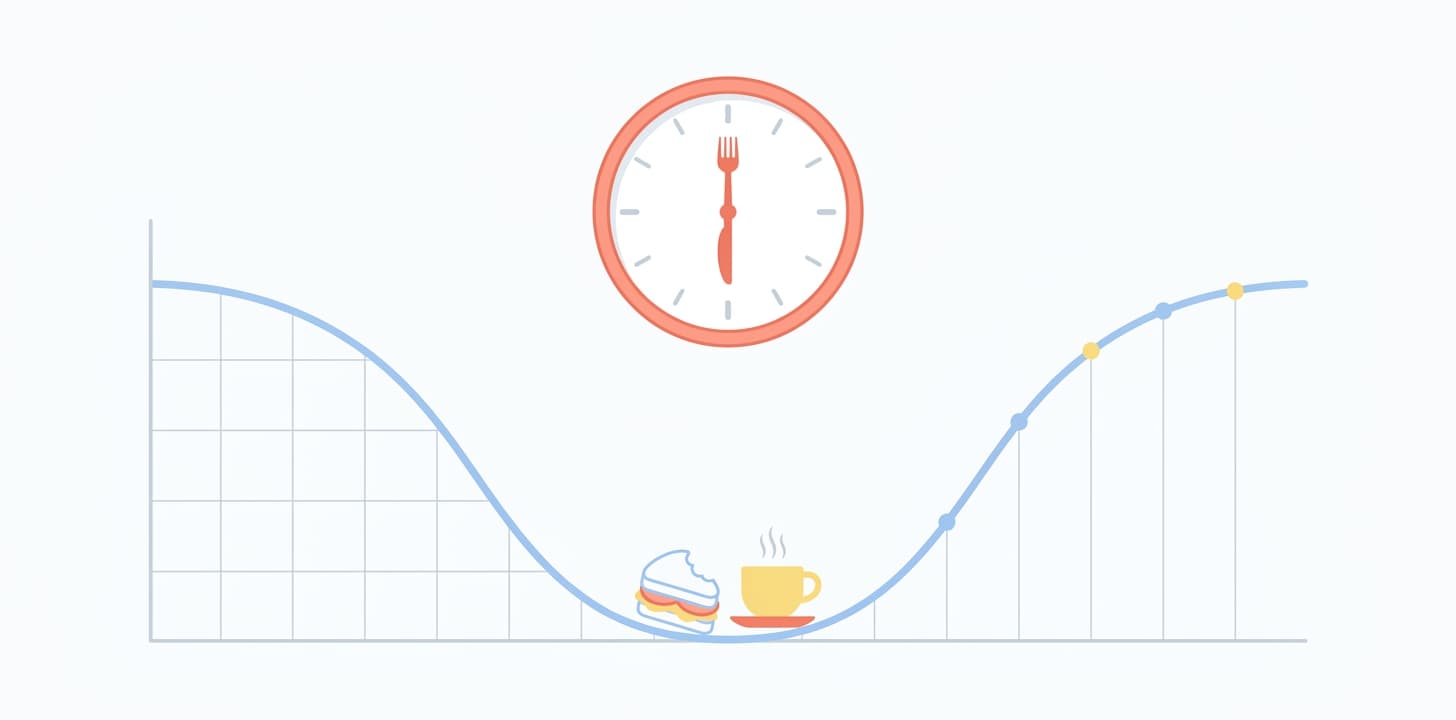
A meeting recorder is a decent lunch detector. Meetings pile up through the morning, then at some point in the early afternoon the curve sags, because nobody schedules a call for the exact moment they want a sandwich. Where the sag lands, how deep it goes, and how long it lasts turn out to be very different depending on where you live.
How we measured it
We took every live recording made with Wave between July 7 and October 5, 2026: phone recordings, desktop, meeting bots, the watch apps, the Chrome extension. Imports and uploaded files are excluded, since a file uploaded at 3 pm tells you nothing about 3 pm. Each recording was spread across every 15-minute slot it was running, so a meeting from 11:40 to 12:20 counts toward 11:30, 11:45, 12:00, and 12:15. Everything is converted to the recorder's local time zone and averaged over Monday to Friday.
The result, for each country, is a curve showing how much recording is happening at every quarter hour of a typical weekday. We scaled each curve so the busiest slot equals 100%, which lets a country with 50,000 minutes sit next to one with 30 million. Only countries with at least 50,000 recorded minutes are included, which gets us to 24. When we say a country's lunch dip is 40%, we mean meeting volume at the quietest point of lunch is 40% below the day's busiest quarter hour.
Averaged across all 24 countries, the meeting day peaks at 11:15 am, bottoms out at 1:00 pm at about 63% of peak, and climbs back to a second, slightly lower peak around 3 pm. That is the shape of the planet's working day in one line. Now for the fun part: almost no individual country actually looks like this.
The early eaters
The United States, Canada, and New Zealand all hit their lunch trough at 12:30 pm, the earliest in the data. The UK, Australia, Germany, the Netherlands, Japan, and the Philippines follow at 12:45.
The US is also notable for how little it stops. At the American lunch trough, meeting volume is still 72% of what it is at the day's peak, a dip of just 28%, the smallest of any country that takes a lunch at all. The quiet window runs from 12:00 to 1:15 pm and then it is straight back into it. This is, we think, the first empirical confirmation of the sad desk lunch. Canadians eat at the same time but take a real break: their dip is 40%, and their quiet window stretches past 2 pm.
Europe takes lunch seriously
Cross the Atlantic and the dip gets later and much deeper. Germany and the Netherlands trough at 12:45 with meetings down 47%. Belgium and Switzerland land at 1:00 pm. France hits bottom at 1:15 pm with meetings cut by 58%, and the quiet stretch runs from 11:45 all the way to 2:30.
Italy is the champion. Italian meetings drop 69% at the trough, which lands at 1:45 pm, and the country stays well below its morning level from noon until 3 pm. Three full hours. The afternoon then runs late, with the Italian meeting day not winding down until about 6:30 pm.
Spain is the one that looks strange until you remember Spanish schedules. The Spanish trough is the latest in the data at 2:00 pm, but the dip is shallow, only 27%. That is because the Spanish day is shaped differently: a long plateau from 11 am to 2 pm, a lull, and then the day's actual peak at 4:15 pm. Spanish meetings keep going past 7 pm. Lunch isn't a break in the Spanish workday so much as a hinge in the middle of it.
Asia: the most punctual lunch on Earth
Japan has the sharpest lunch in the dataset. Meetings fall off a cliff at noon, bottom out at 12:45 with a 65% drop, and are fully back by 2:00 pm. The Japanese afternoon peak is actually higher than the morning one, which is rare; most countries front-load. If you want to schedule a call with Tokyo, 2:15 pm local is the single busiest slot of their day.
Singapore and Malaysia both take deep lunches (64% and 66%) a little later, around 1:00 to 1:30 pm, and the Philippines at 12:45 with a 61% drop. Across Southeast Asia the window is wide, roughly 11:45 to 3 pm.
India is the outlier. The Indian trough comes late, at 1:45 pm, and is shallow at 31%. More interesting is the shape of the whole day: it starts late, around 10:30 am, and the busiest time is 5:15 pm, with meetings still running at 8 pm. That is the signature of a workforce whose afternoon overlaps with the American morning.
Brazil wins lunch
No country stops as completely as Brazil. At the Brazilian trough, 1:00 pm, meetings are down 72% from the day's peak, and the quiet window runs from 11:30 to 3:15 pm. Almoço is not a snack.
The countries that don't do lunch
Two countries in our data have no meaningful lunch dip at all.
Poland peaks at 11:15 am and then drifts gently downward all afternoon. Volume at 1 pm is still 83% of the peak and, crucially, it never comes back up, so there is no afternoon side to mark the end of a lunch break. This is less odd than it sounds: the traditional Polish main meal, obiad, is eaten in the late afternoon after work, and the workday historically started early to make room for it. Polish meetings are mostly over by 3:45 pm.
Mexico is similar for the same reason. The Mexican meeting day has no midday trough. It rises to a peak at noon, then falls steadily and is essentially finished by 2:45 pm. La comida, the main meal, is eaten between 2 and 4 pm, and the recordings suggest the meetings simply end when it starts rather than pausing for it.
While we were in there
A few more things the data told us that have nothing to do with sandwiches.
- India has the longest meeting day, running from 10:30 am to 8:15 pm at half-peak or better. Italy and Spain also run late. New Zealand has the shortest: 9:15 am to 3:30 pm, with Mexico and Poland close behind.
- Friday is a half day almost everywhere. Globally, Friday has 69% of Tuesday's meeting volume. The Friday fade is strongest in India (61%), the Netherlands (63%), and Ireland (65%). It barely exists in Singapore (96%), Kenya (96%), Malaysia (95%), and Belgium (94%).
- Wednesday is peak meeting. Tuesday and Wednesday are tied for the busiest day; Monday is 79% of Wednesday.
- Weekends are quiet, except in a few places. Only about 5% of recorded minutes happen on Saturday or Sunday. Japan, Kenya, and India are the weekend workers at 13% each; the Netherlands, Belgium, Singapore, and Ireland are the lowest at 4%.
The full table
Every country in the analysis, sorted by lunch trough. “Dip” is how far meeting volume at the trough sits below the day's busiest quarter hour. “Quiet window” is the stretch where it stays at least 10% below the morning and afternoon peaks.
| Country | Lunch trough | Dip | Quiet window | Meeting day | Weekend |
|---|---|---|---|---|---|
| 🇺🇸 United States | 12:30 pm | 28% | 12 pm – 1:15 pm | 9 am – 4:15 pm | 5% |
| 🇨🇦 Canada | 12:30 pm | 40% | 11:45 am – 2 pm | 9:15 am – 4:15 pm | 5% |
| 🇬🇧 United Kingdom | 12:45 pm | 33% | 12:15 pm – 2:15 pm | 9:15 am – 4:45 pm | 6% |
| 🇦🇺 Australia | 12:45 pm | 32% | 12:15 pm – 2:15 pm | 9:15 am – 4:45 pm | 6% |
| 🇳🇱 Netherlands | 12:45 pm | 47% | 12 pm – 2:30 pm | 9:15 am – 4:45 pm | 4% |
| 🇩🇪 Germany | 12:45 pm | 47% | 12 pm – 2:30 pm | 9:15 am – 4:30 pm | 8% |
| 🇵🇭 Philippines | 12:45 pm | 61% | 11:45 am – 2:30 pm | 9:15 am – 5:45 pm | 9% |
| 🇯🇵 Japan | 12:45 pm | 65% | 11:30 am – 2 pm | 9:30 am – 5:45 pm | 13% |
| 🇳🇿 New Zealand | 12:45 pm | 33% | 11:30 am – 1:45 pm | 9:15 am – 3:30 pm | 9% |
| 🇧🇷 Brazil | 1 pm | 72% | 11:30 am – 3:15 pm | 9 am – 5:45 pm | 7% |
| 🇲🇽 Mexico | 1 pm | 18% | no rebound | 9 am – 2:45 pm | 7% |
| 🇸🇬 Singapore | 1 pm | 64% | 11:45 am – 2:45 pm | 9:30 am – 5:45 pm | 4% |
| 🇵🇱 Poland | 1 pm | 17% | no rebound | 9 am – 3:45 pm | 7% |
| 🇧🇪 Belgium | 1 pm | 54% | 12 pm – 2:45 pm | 9:45 am – 4:45 pm | 4% |
| 🇨🇭 Switzerland | 1 pm | 41% | 11:45 am – 2:15 pm | 9:15 am – 5:45 pm | 11% |
| 🇫🇷 France | 1:15 pm | 58% | 11:45 am – 2:30 pm | 9:15 am – 5:45 pm | 5% |
| 🇲🇾 Malaysia | 1:30 pm | 66% | 11:45 am – 3 pm | 9:15 am – 6 pm | 8% |
| 🇮🇪 Ireland | 1:30 pm | 47% | 11:30 am – 2:30 pm | 9:15 am – 5 pm | 4% |
| 🇮🇳 India | 1:45 pm | 31% | 1:15 pm – 3:15 pm | 10:30 am – 8:15 pm | 13% |
| 🇿🇦 South Africa | 1:45 pm | 47% | 12:15 pm – 2:45 pm | 9:15 am – 4 pm | 8% |
| 🇮🇹 Italy | 1:45 pm | 69% | 12 pm – 3 pm | 9:15 am – 6:30 pm | 4% |
| 🇦🇪 UAE | 1:45 pm | 37% | 12:45 pm – 3 pm | 10 am – 6:15 pm | 7% |
| 🇰🇪 Kenya | 1:45 pm | 54% | 12:45 pm – 4:15 pm | 9:15 am – 5:15 pm | 13% |
| 🇪🇸 Spain | 2 pm | 27% | 12:30 pm – 4 pm | 9:30 am – 7 pm | 7% |
Caveats, because we're honest people
- This is Wave users, not the general population. Wave users skew toward people who are in a lot of meetings: founders, consultants, salespeople, students, clinicians. Shift workers and chefs are underrepresented, which is ironic.
- Time zones come from where the recording was made, which is right nearly all the time and wrong for people on holiday.
- A dip in recordings means a dip in meetings. We're assuming the reason is lunch. It could be a nap. We support that too.
- The US accounts for about 80% of all minutes, which is why the “world” chart weights every country equally. A minutes-weighted global curve is basically the American one.
Whenever you eat, the notes are handled
Wave records the meeting, writes the transcript, and sends you a summary with action items by the time you're back from lunch, or back from obiad, or back at 4 pm from comida. It works on Mac, Windows, iPhone, Android, and the web, with no bot joining your call. If you'd like us to run this analysis on something else, like when the world takes its coffee break, tell us at support@wave.co.
Learn more about Wave
Try Wave free — record, transcribe, and summarize on your phone.